
Video
Level Down Notification
Reconsiderations + Appeals
Infographics


FAQs
Below are answers to some of the most commonly asked questions about the Settlement. Class Counsel is here to help answer any questions and offers free legal support to Claimants.
- General Information
- Missing Address Information
- Ineligibility
- Compensation
- Estate Claims
- Legacy Fund
- Assistance to Claimants
| Collapse All Questions
General Information
Can I still submit a Claim?
What happens if I missed the deadline to submit missing information?
Once the deadline passes, the Claims Administrator will process your Claim using only the information already on file. This could result in a denial or lower compensation.
How can I check on the status of my Claim?
To check the status of your Claim, contact the Administrator by calling 1.888.221.2898 or emailing IndianDaySchools@Deloitte.ca.
Missing Address Information
What if my Claim has no valid mailing address?
The Claims Administrator will process your Claim using only the information already on file and notices may be treated as delivered on their issue date.
What happens if my Claim is reassessed at a different level and my address information is still missing?
If the Claims Administrator changes your level (either higher or lower), the timelines depend on the change. If there is no valid mailing address, the notice may be treated as delivered on its issue date or may not be sent. The deadlines will still run.
For a lower level, you have 120 days to request a reconsideration and 90 days to appeal. These deadlines will not be extended.
For a higher level, you have 120 days from the notice date to submit any information needed to support the higher level. This deadline will not be extended.
If there is no valid mailing address, the notice may be treated as delivered on its issue date.
Ineligibility
Why was I assessed as ineligible by the Administrator?
- the school, or for the years you attended the school, was not operated and controlled solely by the federal government,
- you opted out of this Settlement,
- you have already received compensation for the same harms through another settlement with the federal government, and/or
- the Claim is on behalf of an estate and the deceased died before July 31, 2007.
The reason for your ineligibility will be listed in the letter from the Administrator. If you have questions about your ineligibility letter, we encourage you to contact Class Counsel at 1.844.539.3815 or DaySchools@GowlingWLG.com.
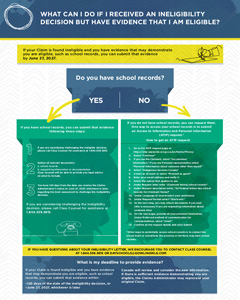
What can I do if I received an ineligibility decision but have evidence that I am eligible?
- 120 days of the date of the ineligibility decision, or
- June 27, 2027, whichever is later.
Canada will review the new information. If Canada agrees that you are eligible, the Claims Administrator will reprocess your original Claim.
Access to Information and Personal Information
- Go to the ATIP request page
- Select “Continue”
- If you are the Claimant, select “my personal information”. If you are Personal representative select “Personal information about someone other than myself”
- Select “Indigenous Services Canada”
- Create an account or select “Proceed as guest”
- Enter your email address and verify it
- Select the option that applies to you
- Under Request label write “[Claimant Name] school records”
- Under Request description write, “All Federal Indian day school records for [Claimant Name]”
- Under Language of record select your preference
- Under Request format select “Electronic”
- At the next step, you may attach documents if you wish (this is necessary if you are requesting information about someone else)
- On the next page, provide all your personal information. Under Preferred method of communication for correspondence, select “email”
- Confirm all the request details and click Submit
I disagree with my assessment of ineligibility. Is there anything I can do about my ineligibility letter?
Please note that if you are ineligible to Claim compensation under this Settlement, you may still bring a separate lawsuit against the individuals or organizations responsible for the abuse you experienced.
If you have questions about your ineligibility letter, we encourage you to contact Class Counsel at 1.844.539.3815 or DaySchools@GowlingWLG.com.
Compensation
Who decides the level of compensation I receive?
The Claims Administrator reviews each Claim Form and determines the level of compensation based on the information and documents you provided.
Will my compensation be taxed or have an impact on insurance payments, pensions, social assistance, etc.?
Social Benefits
The Settlement Agreement provides that there should be no impact on benefits including social assistance, Old Age Security (OAS), and Canada Pension Plan (CPP). For more information, visit section 5.06 of the Settlement Agreement.
The Government of Canada has committed to working with provincial and territorial governments and Federal departments to ensure that any payment Claimants receive will not affect the amount, nature, or duration of any provincial or territorial social benefits. Similar efforts were successful with respect to the Indian Residential School Settlement payments.
Tax
Payments from this lawsuit are not taxable. These payments compensate for abuse and harms at Federal Indian Day Schools or Federal Day Schools. The Canada Revenue Agency makes it clear that litigation damages for personal injuries are not taxable income.
OAS and Guaranteed Income Supplement
There will be no impact on OAS and Guaranteed Income Supplement payments. The Old Age Security Act defines income in accordance with the Income Tax Act. Litigation payments for personal injury, including psychological harm, are exempt from the Canada Revenue Agency definition of income.
The OAS pension is a monthly payment available to seniors aged 65 and older who meet the Canadian legal status and residence requirements. Low-income seniors are also eligible for the Guaranteed Income Supplement which is added to OAS. Neither will be impacted by compensation received from this Settlement.
CPP
There will be no impact on CPP. Eligibility for CPP is based on age and contribution to CPP by working in Canada. It is not based on present income levels but contributions over the beneficiary’s lifetime.
The Claims Administrator assessed my Claim at a lower level than the one I selected. What can I do?
Please read the letter carefully. It explains why your Claim was assessed at a lower level and includes a Reconsideration Decision Form. You have 120 days from the date of the letter to decide what you would like to do next.
You can:
- Accept the level the Administrator has given, or
- Ask for a Reconsideration of your Claim.
If you ask for a Reconsideration, the Claims Administrator will look at your Claim again. You can send in any new or missing information that you think will help show why your Claim should be at a higher level. The Claims Administrator will review your narrative and any new details using the same harm level criteria that appear in the Claim Form.
It is strongly recommended that you contact Class Counsel for free legal help before you make a decision. They can explain your options and help you prepare your Reconsideration request.
If, after the Reconsideration, the Claims Administrator keeps your Claim at a lower level than you selected, you can ask for your Claim to be appealed and reviewed by the Independent Assessor. The Independent Assessor’s decisions are final.
Please note: This review process is only for Claimants who disagree with the level the Claims Administrator assigned. It is not available to people who wish to change their selected level after their Claim Form was first submitted or to challenge an ineligibility decision.
Estate Claims
I know a Claimant who passed away or became incapacitated recently. What should I do?
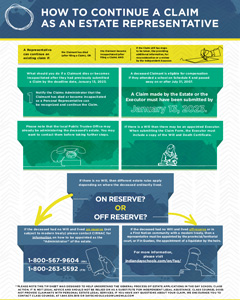
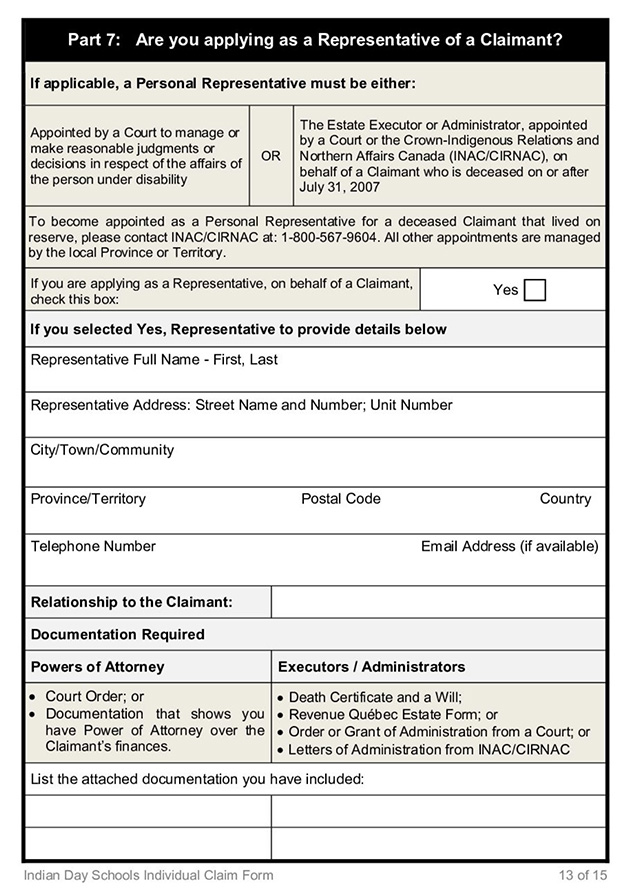
If one of your loved ones who submitted a Claim before January 13, 2023, and has passed away recently, you should notify the Claims Administrator right away. You will need to fill out Part 7 of the Claim Form and provide additional documentation.
Contact the Claims Administrator for more details:
Email: indiandayschools@deloitte.ca
Fax: 416.366.1102
Mail: PO Box 1775, Toronto, ON Canada M5C 0A2
What if the deceased Claimant had a will?
A validly appointed estate representative will have the ability to seek a Reconsideration or Appeal to the Independent Assessor on behalf of the deceased Claimant. For more information, please see the Estates Infographic.
To be validly appointed as an estate representative, Part 7 of the Claim Form will have to be submitted along with supporting documents. Do not send original documents.
What if the deceased Claimant lived on reserve and did not have a will?
- Vital statistics death record or extract
- Church death certificate
- Coroner’s report
- Burial permit
- Internment certificate
You can send the documents to them by mail:
Indigenous Services Canada, Office of the Indian Registrar
10 Wellington Street
Gatineau QC K1A 0H4
OR
By sending them to the ISC Regional Office (contact the Regional Office in the region where the individual died for appropriate address. See phone numbers below.)
OR
By email: Aadnc.Estates-Successions.Aandc@Canada.ca
The Regional Office Numbers are the following:
- Atlantic Region: 1.800.567.9604 or 1.902.661.6200
- Quebec: 1.800.567.9604 or 1.800.263.5592
- Ontario: 1.416.973.6234
- Manitoba: 1.800.567.9604
- Saskatchewan: 1.306.780.5392
- Alberta: 1-780-495-2773
- British Columbia: 1.604.775.7114 or 1.604.775.5100
- Northwest Territories: 1.867.669.2500
- Yukon: 1.867.667.3888
To apply to be appointed as the Estate Administrator, you will need to obtain (1) a copy of the Death Certificate and (2) a copy of the Application for Administration from your Regional Office. Once completed, send the Application for Administration to ISC.
When individuals contact ISC requesting to be appointed as an Estate Administrator, ISC may seek the following information:
- your name and contact information (e.g., address, email, phone number)
- the full name, date of birth, date of death and registration number of the deceased (copy of the status card, if available)
- confirmation of whether the deceased lived on or off reserve at the time of death
- proof of death (see above for acceptable documentation)
- confirmation of whether the deceased had a will
Please note that provincial law governs estate appointments for deceased Claimants who lived in a First Nation community with a “modern treaty.”
What if the deceased Claimant had a will and lived in a First Nation community with a modern treaty?
As Class Counsel, Gowling WLG does not handle any estate legal services related to the Claims process. Prior to taking steps with the court to be appointed as an Estate Administrator, we recommend you seek independent legal advice.
What if the deceased Claimant lived off reserve and did not have a will?
If the deceased Claimant resided in the Province of Quebec, then the heirs must appoint a liquidator. Once appointed, the liquidator may submit a Claim Form along with the following documents:
- Death Certificate;
- Certificate of Will search by Chamber of notaries;
- Certificate of Will search by Quebec Law Society; and
ONE of the following:
- Declaration of hereditary (sworn before a notary, lawyer or Commissioner of Oaths); OR
- A designation of a liquidator by the heirs (e.g. Revenue Quebec form LM-14.1, BD-81.7 or BD-81.4-V).
Please note that if a will is disputed or an estate is contested by family members, the Administrator may require additional documents, including a judgment issued by a superior court and a probated will.
If the deceased Claimant resided in the Province of Quebec and the will or estate is under dispute, the Administrator would require a probate judgment issued by the Superior Court of Quebec or by a Notary authorized by law to probate wills; in addition, the will must be certified by the Superior Court of Quebec or by the Notary who probated the will.
- As Class Counsel, Gowling WLG does not handle any estate legal services related to the Claims process. Prior to taking steps with the court to be appointed as an Estate Administrator, we recommend you seek independent legal advice.
Legacy Fund
What is the Legacy Fund?
The Settlement includes a $200 million Legacy Fund to support commemoration projects, health and wellness programs, “truth-telling” events, as well as the restoration and preservation of Indigenous languages and culture.
For more information, visit https://mcleanlegacyfund.ca/.
Assistance to Claimants
How do I contact Class Counsel?
Email: DaySchools@GowlingWLG.com.
We continuously provide updates through our Facebook Group @McLeanClassAction.
Can I get mental health support?
Phone: 1-855-242-3310 or
Online chat: www.HopeForWellness.ca.
What is the impact of retaining a non-Class Counsel lawyer on my later use of Gowling WLG as Class Counsel?
By signing a separate retainer agreement and/or choosing to use a lawyer other than Class Counsel, the Claimant will be deemed to have given up their access to free legal services from Class Counsel and will be deemed to have released Class Counsel from their obligations to support that particular Claimant.
